If you are thinking about renting out your home, one of the first questions you probably have is:
How much will my house actually rent for?
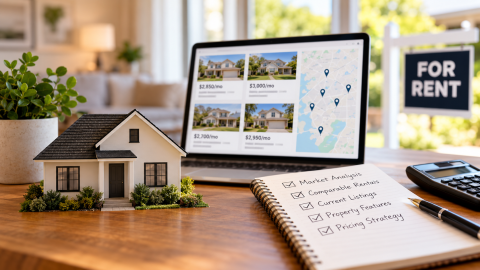
The short answer is that the best way to determine your home's rental value is to compare it to similar homes that have actually rented, while also considering your home's condition, upgrades, location, amenities, competition, and the current rental market.
At Revo Real Estate Group, we don't rely on an automated estimate or simply look at what a few homes are listed for online. We take a much more complete approach to determining a realistic rental range and developing a pricing strategy for your property.
And it starts with seeing the home.
Why We Prefer to See Your Home in Person
Bedroom count, square footage, and neighborhood are helpful starting points, but they don't tell the whole story.
Two homes can be located within a few blocks of each other, have the same number of bedrooms and bathrooms, and even have similar square footage — but renters may view them very differently.
One may have a beautifully renovated kitchen, newer flooring, a fenced backyard, great natural light, a screened patio, and excellent storage. The other may not have been updated in 15 years.
Those differences matter.
That is why part of our rental evaluation process is meeting you at the property whenever possible. Seeing the home helps us understand things that are difficult to capture through public records or an online estimate.
We look at the home's condition, layout, finishes, updates, outdoor space, parking, storage, neighborhood surroundings, and the overall experience a prospective renter will have when they walk through the door.
From there, we can begin comparing your property to the rental market.
We Look at What Comparable Homes Actually Rented For
One of the most valuable tools we have as real estate professionals is access to the MLS.
Most homeowners are familiar with websites such as Zillow, Realtor.com, and other rental platforms. Those sites can be extremely useful, and we absolutely use them as part of our research.
However, there is an important difference between seeing what a property was listed for and knowing what someone ultimately agreed to pay.
Imagine a home was originally advertised at $3,000 per month. After several weeks, the owner lowered it to $2,850.
Eventually, the listing disappears.
If you were watching the property online, you might assume it rented for $2,850.
But perhaps the landlord ultimately negotiated $2,750 with the renter. Or maybe the renter agreed to $2,850 but negotiated something else into the lease. The final transaction isn't always obvious from the property's public listing history.
MLS rental data can give real estate professionals insight into the lease amount reported when a rental transaction closes.
That information is incredibly helpful because we aren't simply asking:
"What are other landlords hoping to get?"
We also want to know:
"What have renters actually been willing to pay?"
That distinction can make a big difference when determining a realistic rental price.
Zillow Rental Estimates Are Helpful — But They Aren't the Whole Answer
Homeowners often search their address online and find an automated rental estimate from Zillow or another real estate website.
These estimates can be useful as a starting point, but they should not necessarily be treated as the price your home will rent for.
An algorithm cannot always account for the things we see when we walk through your property.
It may not fully appreciate that your kitchen was just renovated, that your primary bedroom has an incredible walk-in closet, that your backyard backs up to conservation instead of another house, or that your property has an unusually functional floor plan.
The opposite can also be true. An automated estimate may suggest a rent that looks great on paper but isn't supported by what renters currently have available to them.
This is where pricing based only on an online estimate can become expensive.
Pricing Too High Can Cost More Than Lowering the Rent
When homeowners think about rental pricing, it is natural to focus on getting the highest rent possible.
But the highest advertised rent isn't necessarily the option that makes you the most money.
Vacancy has a cost.
For example, imagine one pricing strategy gets you an additional $100 per month but causes the home to sit vacant for an extra month.
That additional $100 per month equals $1,200 over a full year.
But if the home could have rented for $2,800 and instead sits vacant for an additional month while you try to get $2,900, you have potentially lost $2,800 in rental income trying to gain $1,200.
That is why we look at the bigger picture.
The goal isn't simply to put the highest possible number on your listing.
The goal is to find the best combination of rental rate, market demand, vacancy, and your individual goals as the homeowner.
Sometimes getting an extra $100 per month is worth waiting a little longer.
Sometimes filling the home quickly is much more important.
A good pricing strategy takes both into consideration.
There Is More to a Rental Comparable Than Bedrooms and Bathrooms
When we research comparable rentals, we aren't simply searching for other three-bedroom homes and averaging their rental prices.
We dig deeper.
We look at questions such as:
- How does the condition of the comparable home compare to yours?
- How recently was it renovated?
- How similar is the location?
- How many days did it sit on the market?
- Did the landlord originally price it higher and eventually reduce the rent?
- Did the property rent immediately?
- Does the rent include lawn care?
- Does it include pool service?
- Are utilities included?
- Does the property allow pets?
- Does it have a garage, fenced yard, pool, or other desirable features?
- How does its layout compare with your home?
- What other properties were competing with it at the time?
All of those factors help tell the story behind the numbers.
A comparable property that rented for $3,000 after sitting on the market for 75 days tells us something very different than a similar property that rented for $3,000 in five days.
The rental amount matters.
The days on market and pricing history matter too.
Active Listings Matter Too — Because They Are Your Competition
Closed rental transactions help us understand what renters have recently been willing to pay.
But they aren't the only information we use.
We also look closely at the homes that are available right now.
That includes active rental listings on the MLS, Zillow, and other major rental websites.
Why?
Because those homes are your competition.
If you are preparing to list your three-bedroom home for $3,000 per month and renters currently have eight similar homes available between $2,700 and $2,900, we need to know that.
Likewise, if there is very little competing inventory and similar properties are receiving strong interest, that can affect our strategy as well.
Rental pricing isn't something that should be determined once and then forgotten.
Markets change.
New properties come onto the market. Other homes rent. Owners reduce prices. Demand changes.
That is why we continue monitoring the market after a home is listed.
We Don't Just Set a Price — We Develop a Pricing Strategy
One of the biggest differences between simply looking up a rental estimate and working with Revo is that we aren't just giving you a number.
We are helping you develop a strategy.
After reviewing your home, comparable rentals, active competition, rental history, and current market conditions, we provide a realistic range of what we believe your property should rent for.
Then we talk about your priorities.
Are you trying to maximize monthly rent?
Are you moving out soon and hoping to minimize vacancy?
Would you rather price aggressively and test the market?
Is predictable cash flow more important than holding out for the absolute highest possible number?
There isn't always one universally "correct" answer.
Our job is to give you the information you need to make an informed decision and then help you execute the strategy.
Once your property is listed, we continue paying attention.
We monitor inquiries, qualified leads, showing activity, feedback from prospective renters, competing properties, new listings, and changes in the market.
If the market is telling us something, we want to recognize it quickly.
So, How Much Will My House Rent For?
If you're trying to determine how much your home will rent for, don't rely on one online estimate or simply copy the price of another house in your neighborhood.
A strong rental analysis should consider:
Your specific property + recently rented comparable homes + current competing listings + days on market + property features + renter demand + your individual goals.
That is how we approach rental pricing at Revo Real Estate Group.
And you don't have to become an expert in rental comparables to figure it out.
That's our job.
Get a Free Rental Assessment From Revo Real Estate Group
If you're considering renting out a home in the Tampa Bay area and aren't sure where to start, we'd be happy to help.
There is no pressure and no obligation.
We can start with a phone call or meet you at the property. We'll review the home, research the rental market, evaluate comparable properties, and give you a realistic rental range along with our thoughts on pricing strategy.
We provide this information because we want homeowners to understand their options before making a decision about their property.
Whether this is the first home you've ever rented or another addition to your investment portfolio, you shouldn't have to guess what your property is worth.
Let us take the guesswork out of it.
Contact Revo Real Estate Group to schedule a free rental assessment and find out what your Tampa Bay rental property could realistically rent for.